How to Choose Pneumatic Fittings in 2026

‍

Choosing a pneumatic fitting takes more than matching a connector to a tube. When designing machinery or replacing a component, check the tubing, port thread, sealing method and operating conditions.

‍

A mismatch can cause leaks or unnecessary maintenance. This guide explains how to choose the right fitting and where different Camozzi ranges can help.

‍

Pneumatic Fittings: Quick Selection Guide

‍

Swipe horizontally to view all columns →
Fitting Type or Range Typical Application Main Selection Consideration
Series 7000 GRIPfit Automation Compact industrial machinery Tube OD, reinforced PA66 body and seals
Series 6000 Super-Rapid General automation and control panels Push-in connection, tube and thread sizes
Series 8000 Dual Seal Connections requiring an additional tube seal Tube compatibility and sealing requirements
Series H8000 Dusty environments, including suitable aggregates applications Protection against dirt, tube and seal compatibility
Series 1000 Rapid Push-on connections and compatible low pressure fluids Tube OD and ID, retaining nut and media
Series S2000 Sprint Threaded port connections BSP thread and integrated sealing system
Series HP6000 High pressure lubrication and greasing Fluid, pressure rating and specified tubing
Series X6000 Stainless Steel Corrosive or demanding environments, including selected marine uses Media, environmental exposure and seals
Series 9000 Air Brake Commercial vehicle air brake systems Specified tubing standard and connection

Use this table as a starting point; check each model's tubing, media and operating limits.

‍

‍

Choose the Right Connection Type

‍

Push-in fittings grip compatible tubing. Series 6000 Super Rapid fittings use a brass collet, while Series 7000 GRIPfit Automation uses a stainless steel gripping ring and reinforced PA66 body. GRIPfit supports repeated connection and a long life connection concept that can help reduce replacements and material waste.

‍

Series 8000 Dual Seal fittings add an extra tube seal for applications that require a more reliable leak free connection. They have FKM seals as standard. Check sealing compatibility with the operating conditions.

‍

Push-on fittings, including Series 1000 Rapid, secure tubing over a cone with a retaining nut. Some suit compatible low pressure liquids, including certain oils where specified.

‍

Threaded adaptors connect ports or change direction. Selected Series S2000 Sprint fittings use integrated thread sealing without separate sealant when installed as specified.
‍

‍

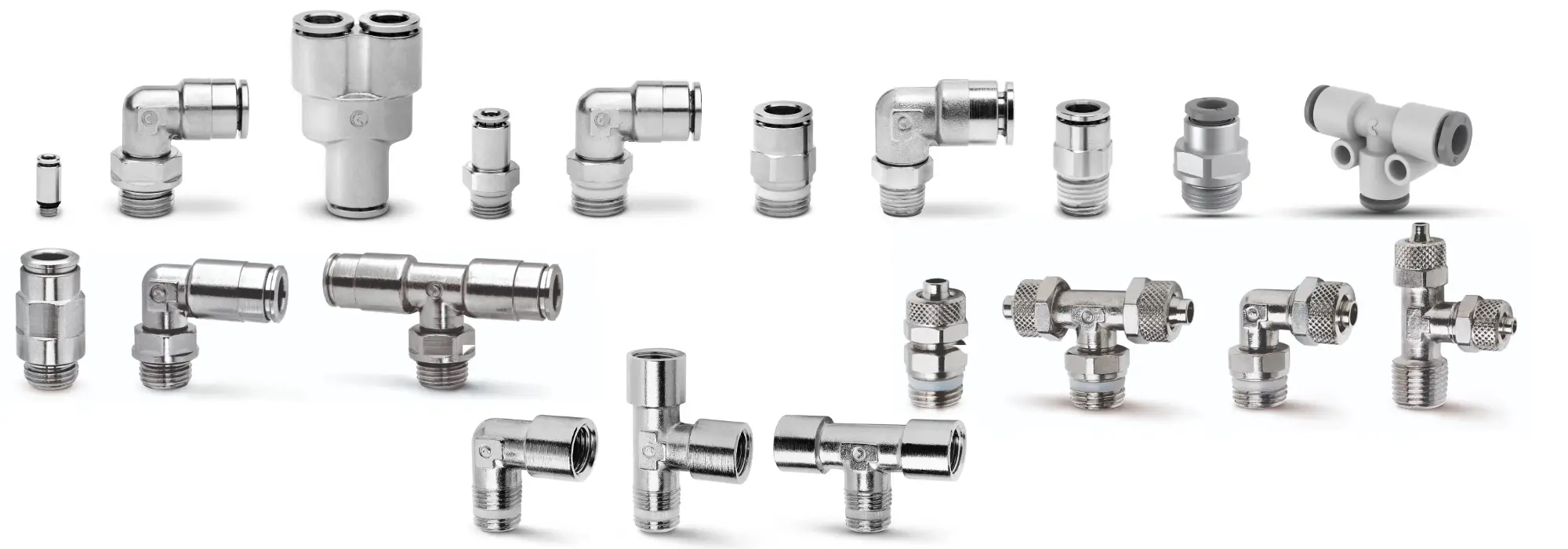
Assorted Camozzi pneumatic fittings showcasing brass and technopolymer push-in, push-on and threaded connection types in straight, elbow and tee configurations.

‍

‍

Check Tube Size, Thread Standard and Sealing Method

‍

Use vernier callipers to measure the tubing's outside diameter (OD) if the size is unknown. For push-on fittings, check the inside diameter (ID) too; 6/4 mm tubing has a 6 mm OD and 4 mm ID. See the Camozzi pneumatic tubing range for available sizes.

‍

Next, check the port thread and sealing method:

‍

  • BSPP (G): a parallel thread, commonly used with a suitable face seal, O-ring or integrated sealing system.

‍

  • BSPT (R): a tapered male thread that needs the correct mating thread and sealing arrangement.

‍

  • Metric (M): often found on compact valves and actuators; the sealing method depends on the connection.

‍

  • NPT/NPTF: North American thread forms that should not be assumed interchangeable with BSP.

‍

Nominal thread sizes can be misleading. Refer to the manufacturer's thread information or drawings to confirm the correct size, thread profile and seal.
‍

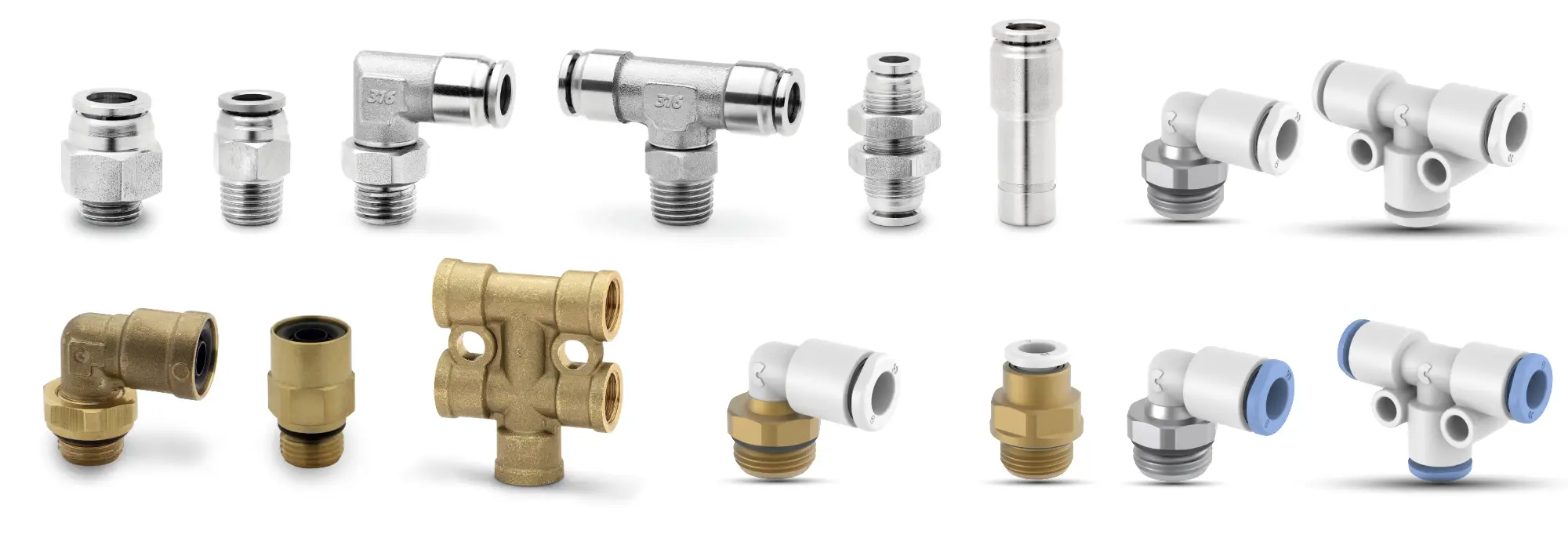
Assorted Camozzi push-in fittings showcasing multiple material configurations, including 316L stainless steel, raw brass and technopolymer bodies for specialist fluid and pneumatic applications.

‍

Match Materials and Specialist Ranges to the Application

‍

Material choice depends on the environment. Reinforced PA66 offers a lightweight option, nickel plated brass is widely used in automation and 316L stainless steel provides corrosion resistance for suitable applications.

‍

Series H8000 is designed for dusty and dirty environments, including suitable aggregates applications. Unlike standard Series 8000, it specifically addresses contamination around the connection.

‍

For greasing and lubrication, Series HP6000 supports oil and grease pressures up to 150 bar, compared with 60 bar for compressed air, subject to model and tubing specifications.

‍

Series X6000 stainless steel fittings may suit certain marine and boat building installations. Check fluid compatibility, corrosion exposure and possible seawater contact.

‍

For other fluids, GRIPfit Cooling uses bio sourced PA11 and EPDM seals for specified cooling duties; GRIPfit Medical and Beverage & Water Filtration serve their own applications. Series 9000 air brake fittings are intended for commercial vehicle air brake systems with specified tubing, including DIN 74324 or ISO 7628.

‍

Always confirm the selected fitting's materials, media and operating limits.

‍

‍

Confirm Operating and Installation Requirements

‍

Check pressure, temperature, media and tubing specifications together, along with airflow, space and whether repeated disconnection is needed.

‍

Cut tubing squarely and follow the assembly instructions. For practical guidance, see Camozzi pneumatics training.

‍

Example: A 6 mm Tube and G1/8 Valve Port

‍

For a G1/8 female valve port and 6 mm OD polyurethane tube, choose a compatible 6 mm push-in fitting with a G1/8 male connection. Confirm sealing and working limits; push-on alternatives also require the tubing ID.

‍

‍

‍

Frequently Asked Questions About Pneumatic Fittings

‍

How do I tell what air fitting I have?

Identify whether the fitting is push-in, push-on, threaded or quick release. Measure tube OD with vernier callipers, and ID for push-on connections.

For threads, identify the diameter, pitch and profile. Refer to the manufacturer's thread information and check the seal before ordering.

What are the 4 main types of pneumatic fittings?

4 common connection types are:

  • Push-in: grips and seals around compatible tubing.
  • Push-on: uses a guiding cone and retaining nut.
  • Threaded adaptors: connect threaded ports and components.
  • Quick release couplings: connect or disconnect matching coupling halves.

Common configurations include straight connectors, elbows, tees, crosses and reducing connections.

Which is better, NPT or BSP pneumatic fittings?

Neither is inherently better; match the equipment's thread. BSPP and BSPT are common in UK and European systems, while NPT is common in North America.

Do not assume BSP and NPT are interchangeable; check the profile and seal.

What is the difference between M, T and V style air fittings?

M, T and V style describe different quick release coupling profiles used with compressed air tools. Match the plug and coupler type; they are not necessarily interchangeable.

These are separate from BSP, metric and push-in connections used in industrial automation.

Can pneumatic fittings be used with hydraulic components or industrial piping?

Not as a direct substitute. Standard pneumatic fittings should only be used with hydraulic components if expressly specified for that duty.

Even at low pressure, temperature, fluid and seal compatibility matter. Threaded adaptors may suit industrial pipework where specified.

Always choose a fitting suitable for the intended medium and application.

‍

Need Help Choosing Pneumatic Fittings?

‍

Explore the Camozzi pneumatic connection range or ask Camozzi UK for technical support for help with tubing, threads or fluids. For machinery projects, see OEM machine builder support; for pneumatic panels, visit the UK Automation Centre.