With operating costs continuing to put pressure on UK manufacturers, improving energy efficiency remains an important part of controlling production costs.
For businesses using pneumatic equipment, compressed air is one area that deserves particularly close attention.
Compressed air is clean, versatile and ideally suited to a huge range of industrial automation applications. However, generating compressed air requires electricity, and an inefficient pneumatic system can consume significantly more energy than is actually needed to perform the task.
The challenge is therefore not to move away from pneumatics, but to retain its advantages while reducing unnecessary compressed air consumption.
Understanding Where Compressed Air Is Being Used
One of the biggest challenges with compressed air is that waste can often go unnoticed.
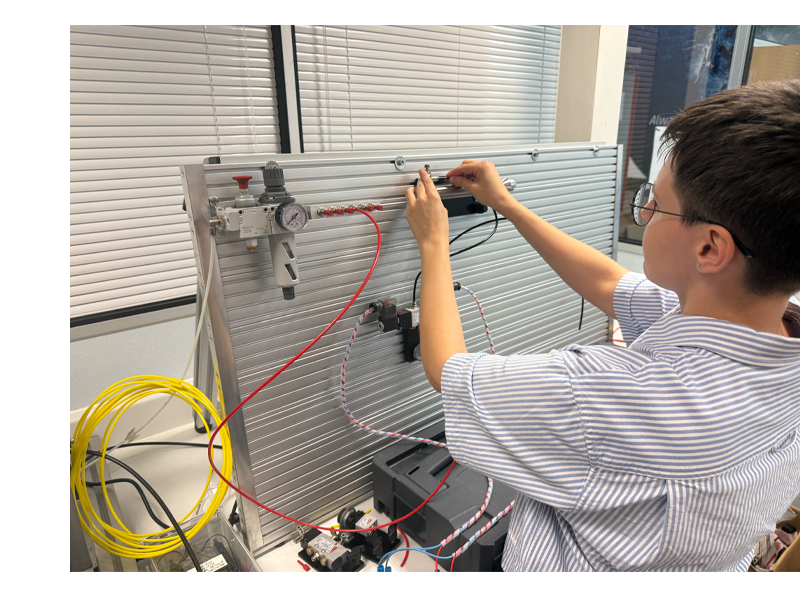
A small leak may appear insignificant, but when this is multiplied across hundreds of fittings, tubes, valves and actuators operating for thousands of production hours each year, the cumulative cost can become significant.
Leak detection should therefore form part of routine preventative maintenance, but leaks are only one potential source of wasted compressed air.
Engineers should also consider:
• Is the system operating at a higher pressure than the application requires?
• Are pneumatic cylinders correctly sized for the load?
• Is compressed air being used unnecessarily for blowing or cleaning?
• Does machinery remain pressurised when production has stopped?
• Is air consumption being monitored effectively?
Each of these areas can provide an opportunity to improve pneumatic efficiency.
Correctly sized actuators, effective air preparation, high-integrity fittings and suitable control technologies can all contribute towards reducing the amount of compressed air required to achieve the same productive output.
Monitoring technology can provide even greater visibility. Flow sensors and intelligent pneumatic components allow engineers to monitor consumption, identify unexpected changes in air usage and use real operating data to support maintenance and efficiency improvements.
Before compressed air consumption can be reduced effectively, it is important to understand where that air is being used — and where it is being wasted.
Could Exhaust Air Be Reused Instead?
During normal pneumatic cylinder operation, compressed air is used to create movement before ultimately being exhausted to atmosphere.
By this point, energy has already been consumed to generate and compress the air. Once it is exhausted, that energy is effectively lost.
Camozzi Automation UK is introducing the Pneu-Saver, a pneumatic energy-saving solution developed to recover and reuse air that would otherwise be exhausted.
Designed for double-acting pneumatic cylinders, the Pneu-Saver can reduce compressed air consumption by approximately 45% in suitable applications.
This figure has been verified in real-world applications using before-and-after consumption measurements taken with an electronic air consumption meter.
Rather than simply discharging compressed air following each movement, the Pneu-Saver recirculates air within the pneumatic circuit. This reduces the quantity of fresh compressed air that needs to be supplied from the main compressed air system.
Turning Compressed Air Savings into Cost Savings
The potential impact becomes clearer when compressed air savings are considered across an entire production year.
As an example, consider a machine using five pneumatic cylinders with 100 mm bores and strokes ranging from 100 mm to 1,000 mm.
If those cylinders operate at 6 bar, between two and ten cycles per minute, across two eight-hour shifts per day, five days per week and 51 weeks per year, compressed air consumption quickly accumulates.
Using an electricity cost of £0.27 per kWh, Camozzi's calculation for this example estimates that introducing a Pneu-Saver could save approximately:
170,756 m³ of compressed air per year
This equates to an estimated:
£5,356 in annual energy costs
and an air saving of approximately:
141.7 litres per cycle
Every pneumatic application is different, and actual savings will depend on factors including cylinder dimensions, operating pressure, cycle frequency and production hours.
However, the example demonstrates how relatively small reductions in compressed air consumption during each machine cycle can build into substantial savings over the course of a year.
A Pneumatic Energy-Saving Solution Suitable for Retrofit Applications
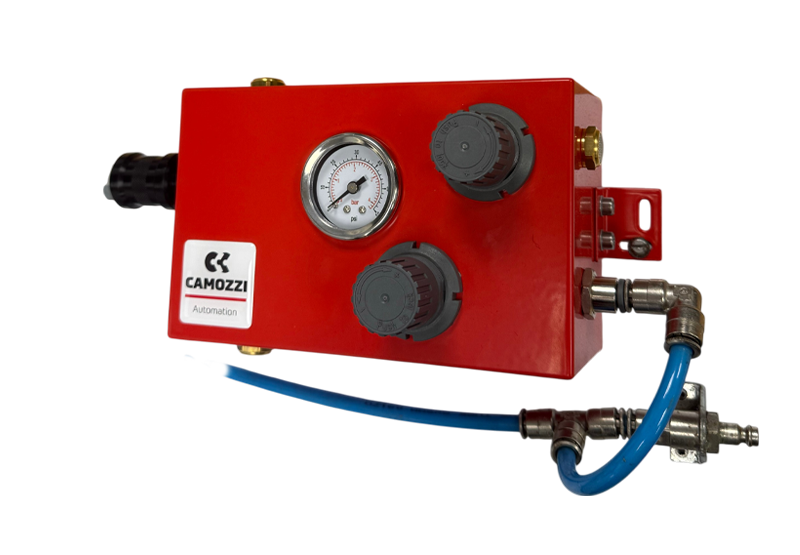
The Pneu-Saver has also been developed with retrofit applications in mind.
Improving pneumatic efficiency does not necessarily mean redesigning an entire machine or replacing an existing pneumatic system.
In suitable applications, the Pneu-Saver can be incorporated into existing machinery with relatively little disruption, providing manufacturers with an opportunity to improve compressed air efficiency without a major machine redesign.
Where machinery has sufficiently high compressed air consumption and operating hours, the resulting savings could potentially allow the investment to achieve payback within 12 months.
Pneumatic Efficiency Is About More Than Components
Technology is only one part of improving pneumatic efficiency.
Some of the most effective long-term savings can come from giving the people responsible for specifying, operating and maintaining pneumatic equipment a better understanding of compressed air.
An engineer who understands the relationship between pressure, flow, cylinder sizing and air consumption is better equipped to identify inefficiency.
Maintenance teams that understand common sources of compressed air loss can identify problems earlier, while machine designers who consider energy consumption during the design process can help prevent unnecessary consumption from being built into equipment in the first place.
This is why energy efficiency forms an important part of Camozzi Automation UK's pneumatic training programme.
Safety & Energy Saving in Pneumatics Training
Camozzi Automation UK's Safety & Energy Saving in Pneumatics course combines pneumatic safety with practical methods for reducing compressed air consumption.
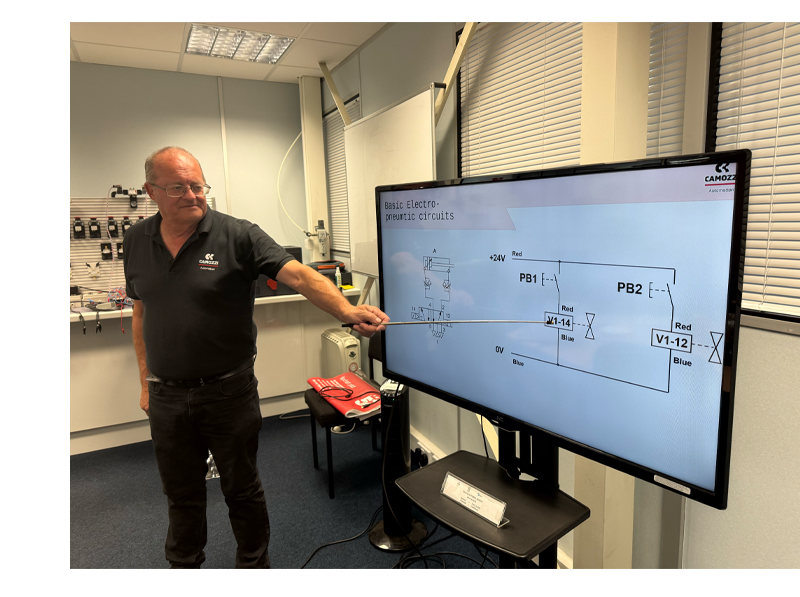
Delivered at the Camozzi Automation UK headquarters in Nuneaton, the one-day course covers areas including:
• Optimising compressed air systems
• Identifying sources of unnecessary air consumption
• Understanding the relationship between pressure, flow and energy usage
• Improving pneumatic system efficiency
• Identifying opportunities to apply energy-saving technologies such as the Pneu-Saver
The objective is not simply to introduce individual products, but to help engineers look at pneumatic systems differently and identify opportunities for improvement within their own machinery and processes.
Small Pneumatic Efficiencies Can Create Significant Savings
There is no single solution to reducing industrial energy consumption.
Instead, manufacturers can examine where energy use can be measured, questioned and improved.
Within a pneumatic system, that could mean finding leaks, reducing unnecessary operating pressure, correctly sizing components, improving maintenance, monitoring consumption and reconsidering established practices.
It can also mean asking a simple question:
Does compressed air that has already been generated really need to be exhausted and lost?
Every cubic metre of compressed air that does not need to be generated represents energy that does not need to be purchased.
By combining good pneumatic system design, effective maintenance, intelligent monitoring, energy-saving technologies and appropriate training, manufacturers can reduce waste while continuing to benefit from the flexibility and reliability of pneumatic automation.
Improve the Efficiency of Your Pneumatic System
Want to understand where your compressed air is being used or explore whether the Pneu-Saver could reduce consumption within your application?
Speak to the Camozzi Automation UK team about pneumatic energy efficiency, the Pneu-Saver and our pneumatic training courses.